
Turkey and Iran Maintain a Pragmatic Approach to Neutrality

Chethana Janith, Jadetimes Staff
C. Janith is a Jadetimes news reporter and sub-editor covering science and geopolitics.
Iran and Turkey, despite potential points of tension, adhere to a pragmatic policy aimed at avoiding an escalation of the conflict and preserving their national interests in view of the complicated situation unfolding in the region.
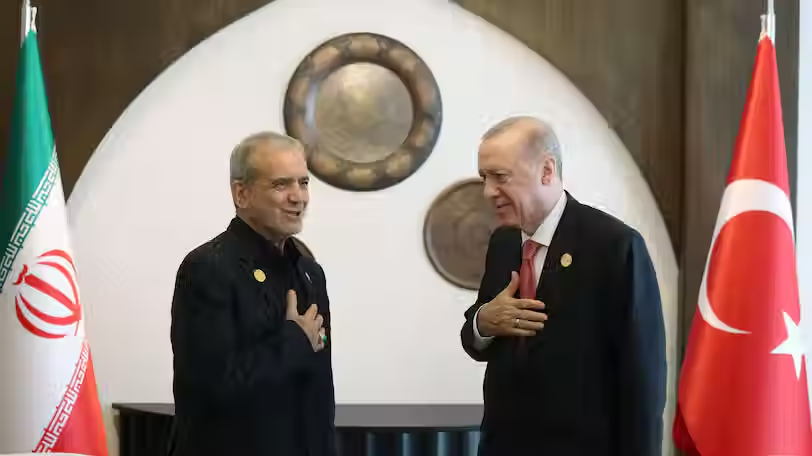
Why Iran does not attack American military bases in Turkey
In March, there appeared reports that Iran had launched ballistic missiles towards Turkey, in the vicinity of American and NATO military bases of Incirlik and Kürecik. According to available data, however, those missiles did not reach their targets and were intercepted by NATO’s missile defence system in Turkish airspace. The incidents caused no serious destruction or casualties.
Notably, every single time, the Iranian authorities have denied any involvement in these strikes. According to their statements, the strikes could have been provocations by Israel and the United States aimed at dragging Turkey into a military confrontation with the Islamic Republic.
Ankara, for its part, threw its indirect support behind Tehran’s position. President Recep Tayyip Erdoğan has repeatedly stressed that Turkey will not allow itself to be drawn into an anti-Iranian conflict and that it is aware of attempts by external forces to ignite regional conflagration. At the same time, Turkey has not ruled out the possibility of such incidents having been triggered by internal developments in Iran, such as the death of the supreme leader, the decentralisation of power, and the growing influence of the Islamic Revolutionary Guard Corps (IRGC).
With the onset of the second anti-Iran campaign, Iran adopted a tactic of dispersed strikes against US military and political infrastructure in Arab countries. Iranian drones and missiles have targeted both American bases and economic infrastructure - primarily oil fields and transport links - of Gulf monarchies, including Bahrain, Saudi Arabia, the UAE, Jordan, and Kuwait.
Pragmatism instead of friendship: the reasons for Iran’s restraint
Despite tensions in the region, Iran refrains from escalating relations with Turkey. This decision is dictated not by friendly or allied ties - indeed, Turkey and Iran are historical rivals in the Middle East and neighbouring regions, including the South Caucasus and Central Asia. Both countries are guided by their own pragmatic interests, which provides for them maintaining partnership and avoiding direct military collision.
Preventing the expansion of the conflict: Tehran does not wish to trigger an escalation that could lead to retaliatory strikes and an expansion of the combat zone, which would, on its part, threaten Iran’s own interests.
Turkey’s NATO membership: Involving Turkey in the conflict could activate Article 5 of the NATO Treaty, potentially drawing the entire alliance into the confrontation.
Risk of expanding the anti-Iran coalition: Turkey’s participation could prompt other countries of the Organization of Turkic States (OTS), such as Azerbaijan, to join an anti-Iran coalition.
Threat of regional chaos: Such a development could plunge the Middle East into the chaos of an intra-Islamic conflict.
Military balance: The military arsenals of Iran and Turkey are balanced in some aspects, but in a number of areas (for instance, combat aviation and armored vehicles), Turkey holds an advantage.
Involving Pakistan: A military conflict with Turkey on the western front could provoke Pakistan’s entry into an anti-Iran coalition on the eastern flank, creating a staging ground for a US-led ground operation.
The Kurdish question: The Kurdish issue represents a potential secessionist threat for both countries. A conflict between Iran and Turkey could galvanise the Kurdish movement for independence.
Energy partnership: Iran is an important supplier of natural gas to Turkey (8–16 billion cubic metres annually). This partnership benefits Iran under sanctions and meets Turkey’s energy needs.
All these factors, taken into account altogether, rule out the possibility of Iran provoking Turkey.
Turkish neutrality towards Iran: reasons and benefits
From the very outset, President Recep Tayyip Erdoğan adopted a stance that differed from the aggressive rhetoric of the United States and Israel towards Iran. He assessed the actions of Washington and Tel Aviv as an “open violation of international law” and a “deliberate provocation” on the part of Benjamin Netanyahu’s government. At the same time, Turkey has not refrained from criticising Iran’s retaliatory strikes on the territory of Arab states, which outwardly underscores its neutral position. Ankara consistently advocates cessation of hostilities and resumption of the negotiation process, offering its mediation services. The Turkish Ministry of Foreign Affairs takes an active part in diplomatic efforts, including on the platform in Islamabad.
The incident in which Iranian ballistic missiles fell on Turkish territory triggered a sharp reaction from Ankara. Turkey has reiterated the unacceptability of such provocations and its readiness to take decisive measures in response. It has also been emphasised that the country’s defence system is at full combat readiness, yet Turkey has no interest in escalating the regional conflict and does not seek to become involved in it.
Why isn’t it lucrative for Turkey to participate in the conflict against Iran?
Participation in a military confrontation with Iran presupposes a series of serious risks and unprofitable consequences for Turkey:
Iran’s military capability: The experience of Iran’s counter-strikes against the territory of Arab countries and US military infrastructure showcases Tehran’s significant military potential. This capability is able to deliver a painful and devastating blow to Turkey’s critical energy, industrial and communication facilities.
Vulnerability of critical infrastructure: on Turkish soil, there are strategically vital sites, including the American Incirlik airbase with its nuclear arsenal, the Akkuyu Nuclear Power Plant, and key oil and gas pipelines. In case of a sparked conflict, these sites could be prioritised by Iran as military targets.
The Kurdish factor: to an equal or possibly even greater extent than external threats, Kurdish armed resistance led by the PKK is a serious peril for Turkey’s internal security. In a military conflict with Iran, given the compact settlement of Kurds along the 560‑kilometre Turkish-Iranian border, there is a high probability of a resurgence of their activity.
Energy security: a war with Iran would halt Iranian gas supplies, causing a blue fuel deficit for Turkey of some 15–16 per cent.
Regional balance of power: the weakened Iran would inevitably lead to the strengthened Israel in the region. This, in turn, would diminish Turkey’s chances of realising its ambitions of being the Middle Eastern leader.
Undesirable regime change in Iran: Ankara does not stand to gain from a change of the Iranian regime in favour of a pro-American and pro-Israeli opposition. In that scenario, the United States would acquire a new, resource-rich ally in the region, which would run counter to Turkey’s interests. Moreover, external interference in Iran’s domestic affairs, by analogy with the experiences of Iraq, Libya, and Syria, could plunge the country into the chaos of a civil conflict.
Uncertainty of outcome and high losses: a war with Iran does not guarantee Turkey a landslide victory, but comes with high risks of new threats and losses. Among them are a potential influx of millions of Iranian refugees, a heavy financial burden on the budget, and a deepening of the socio-economic crisis.
Vulnerability to Israel: Turkey’s participation in a military conflict with Iran would undermine its positions and leave it vulnerable to possible Israeli aggression.
Assessment of Iranian concerns and NATO’s position
There is an outlook in Turkey that Iran fears a military conflict with Ankara for the following reasons:
(a) The Turkish army surpasses the Iranian army in terms of training and arsenal;
(b) Turkey is a member of NATO, and an attack on it could trigger the implementation of Article 5 of the alliance’s treaty.
However, as the two Iranian wars against the US–Israel coalition have shown, Iran possesses a no less combat-capable army and has a sufficient stock of weaponry, especially in the field of unmanned aerial vehicles and ballistic missiles.
In terms of Iran’s blockade of the Strait of Hormuz and President Donald Trump’s reiterated calls to expand the coalition and carry out a joint military operation, NATO countries have in fact unanimously denied support to the United States. It is difficult to predict how France, Greece, the United Kingdom, and Germany would react in case of Iranian air strikes on Turkish territory if Ankara were to launch military action against Iran first. This scenario highlights the complexity and multifaceted nature of regional geopolitics, where every step carries far-reaching consequences.
Hence, Turkey’s neutral stance is dictated by a pragmatic calculation aimed at minimising risks and preserving its national interests amid a complex and unstable regional landscape. Ankara seeks to play the role of a stabilising force, offering diplomatic paths to resolving conflicts rather than being drawn into costly and potentially destructive military confrontations.


Comments