
Sri Lanka’s financial sector experiences rising interest rates and policy uncertainty amid strong loan demand and post-Cyclone Ditwah recovery

Himasha Dissanayake, JadeTimes Staff
H. Dissanayake is a Jadetimes news reporter covering Economy
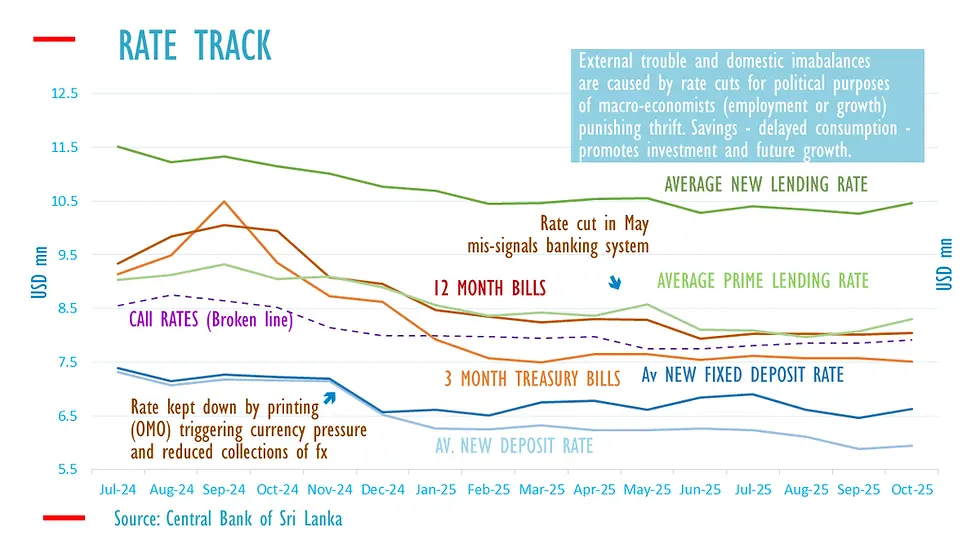
Sri Lanka’s lending and deposit interest rates edged higher in October despite a rate cut earlier in the year, as strong loan demand pushed banks to aggressively raise deposits. Official data shows that this rise comes after months of inflationary open-market operations, including the injection of 100 billion rupees in August and September 2024, which mis-signalled credit conditions.
Alt text: “Sri Lanka’s financial sector experiences rising interest rates and policy uncertainty amid strong loan demand and post-Cyclone Ditwah recovery.”
From September onward, liquidity was injected at 8.26 percent—effectively implementing a floor-rate system—fueling public criticism and reviving concerns around flexible inflation targeting. Analysts warn that such policy frameworks have historically contributed to balance-of-payments stress, currency depreciation, and economic instability.
In 2025, the rupee again depreciated as current account deficits widened, raising fears of a return to problematic monetary practices. Market-based interest rates, experts note, are essential for maintaining external stability, containing credit cycles, and limiting mal-investment.
Banks previously expanded credit without raising deposits due to inflationary liquidity injections and government securities monetization, both of which contributed to past currency crises.
The recent arrival of Cyclone Ditwah adds a new layer of uncertainty. Economists say any shock that reduces loan demand could generate a balance-of-payments surplus and push down interbank rates—if the central bank absorbs the resulting foreign exchange inflows. However, unlike the 2004 tsunami, Ditwah has not significantly altered public sentiment, with communities quickly pushing toward recovery.
The government plans to allocate an additional 500 billion rupees in 2025 for Ditwah-related efforts. Meanwhile, the IMF is preparing a 200-million-dollar credit facility, and further international assistance is expected following World Bank assessments.


Comments