
Takeoff of China’s flying taxis hits turbulence amid rapid low-altitude growth

Himasha Dissanayake, JadeTimes Staff
H. Dissanayake is a Jadetimes news reporter covering Technology
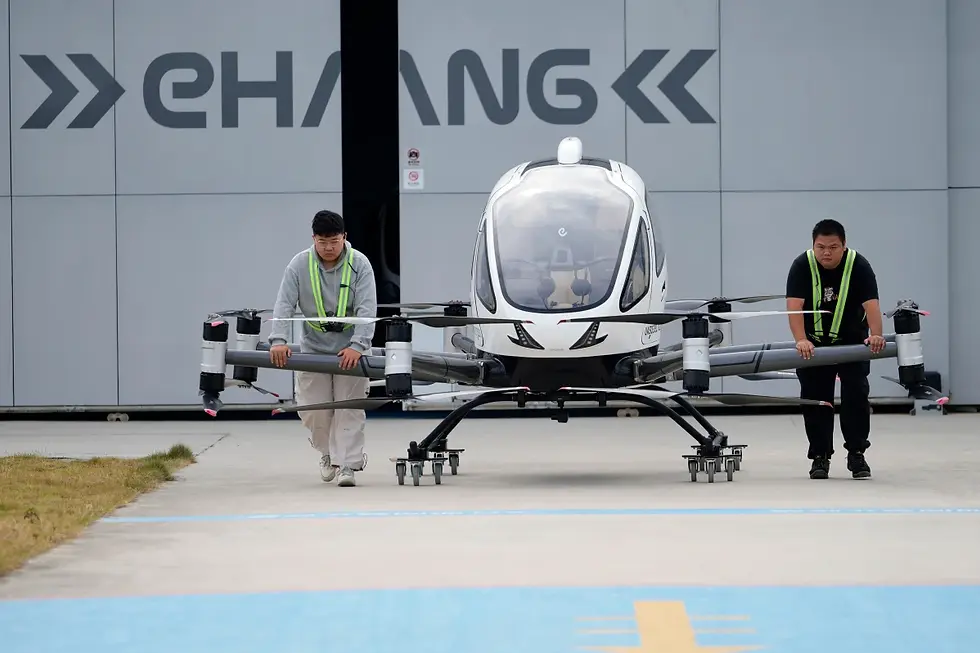
Source: AP Photo/NG Han Guan
China’s efforts to commercialize flying taxis and low-altitude aviation are accelerating, yet safety challenges, battery limitations, and strict airspace rules are slowing the industry’s full takeoff. In Guangzhou, an unmanned oval-shaped flying taxi by EHang hovers over a riverside technology zone, symbolizing a future where urban aerial mobility could become a daily reality. Nearby in Shenzhen, drone-delivered food has already become a novelty tourist attraction, hinting at the commercial potential of low-altitude services despite higher costs.
Industry analysts say China’s “low-altitude economy,” which ranges from delivery drones to electric flying vehicles, generated 506 billion yuan (USD 70 billion) in 2023. Driven by government incentives, it is projected to soar to 3.5 trillion yuan (USD 490 billion) by 2035. Guangdong province leads this boom, home to major players such as DJI, XPENG’s flying car unit ARIDGE, logistics drone provider Phoenix Wings, and EHang, which recently received regulatory approval to offer pilotless passenger flights.
Still, the skies are far from clear. Battery technology limits flight duration, and access to airspace below 1,000 meters remains restricted, with less than one-third currently available for general aviation use. Safety concerns intensified after two XPENG eVTOL aircraft collided during a rehearsal in September, resulting in a fire that forced other exhibitions to cancel flying demonstrations. Some global peers have already faltered: German air taxi makers Lilium and Volocopter faced financial fallout, with the latter later bought by a Chinese-owned company.
Authorities are loosening airspace controls, and reforms in civil aviation law are being drafted to support commercialization. Experts predict that passenger-carrying tourism flights may begin around 2030, with rooftop terminals and citywide mobility networks envisioned as part of China’s future urban infrastructure.
Despite risks and regulatory hurdles, China’s centralized planning, strong manufacturing base, and growing investment suggest a promising takeoff ahead. As Hong Kong Polytechnic University researcher Chen Wen-hua notes, “The future for the low-altitude economy is bright — however, the road leading to that bright future might be treacherous.”





Comments