
The Rise of AI Agents

Ravichandran Harini, Jadetimes Staff
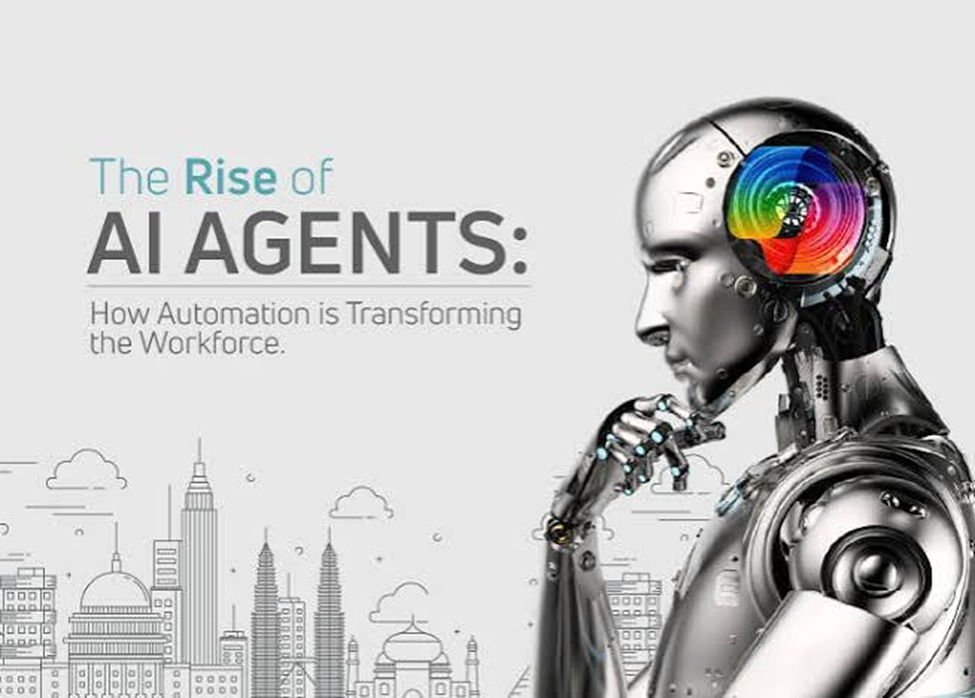
Why Intelligent Digital Assistants Are Changing the Way We Work and Live
At 8am, a hospital administrator asks her digital assistant to reschedule twelve appointments, flag two insurance claims for review, and draft a follow-up email to a specialist. Ten minutes later, it is done. She never touched a form or dialed a phone. A few years ago, this would have taken half her morning. Today, it barely interrupts her coffee.
This is the quiet revolution of AI agents: systems that do not just answer questions but complete work. Unlike a traditional chatbot, which waits for a prompt and replies with text, an AI agent perceives its environment, reasons about a goal, plans a sequence of steps, and acts, often across several digital tools, with minimal human hand-holding.
Under the hood, three ideas make this possible. Memory lets an agent recall earlier instructions and context rather than starting fresh each time. Planning breaks a broad goal, such as "organize my week", into smaller executable steps. Reasoning and tool use let the system decide which app, database, or calendar to touch next, and in what order, adjusting its plan when something changes.
The effects are already visible across industries. In healthcare, agents triage patient messages and summarize records. In finance, they monitor transactions for fraud and compile reports in minutes rather than days. Software developers use coding agents to write, test, and debug entire modules. In customer service, agents resolve routine tickets end-to-end, escalating only the complex cases to humans. Researchers deploy them to comb through literature and organize findings for review.
Major technology companies are racing to build this next layer of AI. Open AI, Google DeepMind, Microsoft, Anthropic, NVIDIA, and Salesforce have each released agent platforms or frameworks aimed at enterprise workflows, from customer support bots to autonomous coding assistants. The pace of adoption is striking: Gartner forecasts that 40% of enterprise applications will be integrated with task-specific AI agents by the end of 2026, up from less than 5% in 2025, one of the fastest technology shifts the sector has tracked.
That speed brings real tension. Agents that can act independently raise fresh questions about privacy, since they often touch sensitive data across multiple systems. Security risks multiply when software can take actions on its own. Bias embedded in training data can shape decisions at scale, and accountability becomes murkier when no single person clicked "send." Job displacement concerns are real, particularly in roles built around repetitive digital tasks. None of this is hypothetical anxiety; it is the reason governance frameworks are now a boardroom priority alongside deployment plans.
AI agents mark a genuine shift, not just a faster chatbot. They are becoming collaborators, handling the multi-step, tool-spanning work that once required a human at every turn. How well societies govern that shift will decide whether it delivers broad benefit or new forms of risk.




Comments